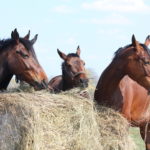



I’m getting to know our newest addition to the herd at the Equine Research Foundation-a Tennessee Walking Horse named Jack Daniels who’s retired from the show ring. Whenever we get a new horse, whether its one we bought or one that was donated, I always take things slowly. Starting from the ground, I get to know how he moves and how he thinks, and I work on developing a strong bond before even considering saddling up. This time, however, I’m taking things even slower.
Jack Daniels bears scars from his show horse years. No hair grows on parts of his pasterns due to soring by chains and other damaging agents. His tail flops weirdly, because it had been cut and set by a contraption designed to create a tail carriage similar to a Shih Tzu. During his show years he wore platform shoes, causing him to move in an exaggerated manner; even now, barefoot, he has an odd gait.
When I look at Jack, it’s obvious what has been done to him physically, but I’m still learning about what may’ve happened to him mentally. I wonder: Did years of abuse affect his mind or, for that matter, can he even remember what had been done to him? Although I may wish that those tough times were indeed a thing of the past, in all likelihood Jack recalls those days with clarity.
Do horses remember what happened to them years ago, or for that matter, a month, a week, a minute ago? Ask any horse person and, most likely, you’ll get an assortment of opinions. Even equine researchers don’t agree on how well horses remember.
Short-Term Memory
Take, for example, short-term memory-the stage in which things are learned temporarily and may be retrieved over a brief period of time. Humans use short-term memory for such tasks as keeping a phone number in mind for a few moments. In one scientific study with horses, a researcher reported that horses had poor spatial short-term memory for varying locations of feed.
This conclusion struck me as unusual, because-in my experience as both a researcher and a trainer-I’ve frequently observed horses easily remembering locations, not only of food, but also of food-rewarded objects and other stimuli.
It’s always risky to draw conclusions about a horse’s ability based on the negative findings of one report. Just because one study fails to show a certain ability, this doesn’t imply that all horses are incapable of it. It just means that additional research using different or more appropriate designs is needed.
So, with the help of our learning and riding vacation participants, the Equine Research Foundation (ERF) took a further look at short-term memory. Our horses performed quite well on spatial short-term memory tests. They kept mental images of different locations of food signals for as long as 20 seconds, which was the maximum delay tested.
While this is interesting information from a scientific standpoint, what’s the practical value in this knowledge for horse owners? The fact that horses do have good short-term memory means that, as trainers, we need to make sure that our cues are clear and consistent each time we give them. A mistake on our part can’t be quickly erased or forgotten, so teaching a cue and training a behavior correctly the first time is key in helping our horses understand what we want.
We can also clearly see now that timing is everything. Even though horses can effectively use their short-term memory, it can be interrupted, so the reinforcement must be given immediately. Bad timing in reinforcing effort leads to miscommunication and confusion, followed by the horse making the wrong associations.
Long-Term Memory
Besides short-term memory, we were also interested in learning more about equine long-term memory. Just from practical experience, many of us have the impression that horses remember events-especially negative ones-for quite a while. Each one of us probably has known a horse that had been frightened in a particular area once and subsequently acted up each time he approached the same spot again.
Memory can also be critical for a horse’s very survival. Free-ranging horses must learn and remember their social, biological, and physical environments, which change often. Wild mustangs must remember food and water locations. Individual horses can separate from the group and then later reunite, which demonstrates the ability to recognize and remember herd members.
The fact that horses adapt so well when situations do change suggests that they have the ability to recall not only specific objects and events, but are also capable of grander cognitive achievements.
Yet, in the past, no research had been done regarding long-term memory for advanced learning abilities in horses. This lapse was primarily due to the time-intensive requirements of these studies, beginning with the meticulous collection of original data and ending with retesting the same horses several months to many years later.
In the past, I’ve frequently observed horses using what appeared to be long-term memory, but I hadn’t done an actual study of it. So, when I got the chance to examine the ERF horses’ long-term memories, I jumped at it! One of the main purposes of the ERF is to investigate advanced learning in horses, and either verify common beliefs or disprove myths and misconceptions.
For example, our research has shown that, contrary to popular opinion, horses aren’t color-blind but they also don’t see colors as well as we do. Their color vision is similar to people with red-green color deficiencies. The ERF also dispelled the old myth that horses can’t recognize with one eye what they had previously only seen with the other eye; rather, they easily transfer information between their eyes (known as interocular transfer) when they’re allowed to pay attention to their surroundings.
This led us to investigate further why horses startle at objects they have seen before but going in the opposite direction. In a study on mental rotation, we found that horses recognize objects in their environment from a number of different angles (front, back, side, or top) but not from all angles (bottom). It seems that as long as horses are allowed to look at and learn about objects, they can remember and recognize them based on just some visible features. Only when objects are viewed from an angle where no familiar features are visible do horses have difficulty recognizing them.
Therefore, it’s important to let your horse look around at his surroundings when you ride or lead him, instead of restricting his head position or keeping him on too short a rein. Horses that are allowed to learn about their environment tend to be calm and casual instead of nervous and flighty.
The misconception that horses aren’t very intelligent and can’t think beyond fairly simple measures is still out there. But, today, there’s a growing body of scientific literature contradicting this belief. Years ago, the ERF showed that horses do indeed have certain high-level cognitive abilities, including the capability to categorize and use concepts to some degree. These studies provided strong evidence that horses do possess more advanced learning abilities than many people thought possible.
After we finished these studies, we moved on to other unrelated topics, so the horses hadn’t seen the objects or worked with the concepts for many years. Then, in 2007, we modified our testing procedures by incorporating LCD computer displays into our system. Thus, the first long-term memory study for advanced learning in horses came about.
As no one had ever formally tested horses using LCD displays, we had no idea how they would react to the screens or if they could even effectively see objects shown on the displays. To find out, we needed to use objects that the horses understood. Resurrecting a past study on relative size concepts, we retested our Arabian Horse, Tequila, and discovered that-more than seven years later-he remembered the concept and could still correctly choose objects based on size. And more than 10 years after finishing another study, our Paint Horse, Coco Bean, still performed as perfectly as he had when originally tested.
Even more remarkably, when we displayed new, never-before-seen objects, the horses knew what to do and made the correct selections. This told us that they weren’t just remembering individual items from their pasts, but that they were also recalling rules and concepts that helped them in problem solving. This ability allows horses to apply familiar rules when confronted with new situations.
What We Learned
As I mentioned earlier, this amazing recall capability is of great interest to the scientific community, but how do these results help you? Now you know definitively that horses remember things they’ve learned for weeks, months, even years after the last training session or learning episode. They’re not merely conditioned-response animals. (A conditioned-response is an automatic response made by an animal once it associates an experience with a neutral stimulus.)
You now know that horses learn quickly given the right motivation. Long, mundane training sessions aren’t necessary or effective; in fact, horses learn better in short sessions. In training, horses will often show sudden improvement in learning when they’re given a break and allowed to settle on a problem.
Events that happened in the past greatly influence your horse’s behavior. When these events were positive, these memories enhance later learning and interaction. Likewise, negative experiences become fixed in memory so strongly that your horse will display fear or anxiety whenever the same or comparable situations arise.
What they learn early in life remains part of your horses’ memory in adulthood, so thoroughly understand desensitization training whenever you work with your very young horse.
Poor horse handling early on may cause a fear reaction toward later events that otherwise would’ve been benign. Additionally, if you treat your horse as a pet rather than staying in harmony with his nature, don’t be surprised if he learns early on to manipulate you, which can lead to dangerous behaviors.
During general handling and riding at the ERF, our horses are encouraged not only to participate, but also to make decisions. We find that-in connection with memory recall-the more the horses are stimulated, the faster new experiences are learned and the better they learn to learn.
Creating Positive Memories
With the help of positive memories, our horses easily adapt to new experiences, whether they’re being exposed to unusual objects during training or navigating rough surf on a beach.
Jack Daniels probably has some horrifying memories from his distant past. This is something I’ll need to remember. We’ll take as much time as he needs to give him pleasant new memories that will help form a trusting relationship.
Because horses are so adaptable, with time, patience, and training know-how we can help them overcome most negative experiences, retrain just about any undesirable behavior, and replace bad memories with good ones. Equine memory is extraordinary. It’s up to us to treat it wisely