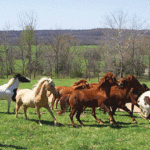


Fencing needs to be a barrier, not a deterrent. Foals don’t see well initially and aren’t born with an understanding of electric tape. They are also notorious for lying down for a nap on one side of the fence, rolling under it and getting up on the other side.
They should be turned out only in a safe area, which means no barbed wire, no hot wire, and no high-tensile. The fence needs to be highly visible and capable of bouncing a high-energy foal back off it without injury.
Studies have documented for years the importance of turnout, preferably 24 hours a day, on the health and biomechanical maturation of young foals. You will need ample pasture and protection from the environment. That means: rain, hot sun, high wind and insects. A deep, three-sided shed is ideal, providing it’s large enough for all the occupants to maintain their personal space. To minimize the risk of an unfortunate kick, mares with foals should not be pastured with open mares or geldings.
Question 3: Money
If all those improvements and adaptations to your existing facility sound expensive, we’ve only just begun. Raising a foal is a pricey endeavor (see sidebar, Show Me The Money). You need to consider stud fees, the sometimes astronomical veterinary fees for getting the mare in foal, the cost of maintaining the mare throughout her pregnancy and while nursing, and the money spent on the special needs of the foal.
If you’re going to give your foal the best chance to reach its genetic potential, you also need to have your feed analyzed and balanced by an equine nutritionist. This attention to mineral imbalances must start with the mare’s diet, well before she’s bred, and persist during pregnancy, lactation and especially throughout the foal’s early years (see ”Feeding The Pregnant Mare” article in this month’s issue).
Things can and do go wrong: Are you prepared to pay for a few weeks in a neonatal intensive care unit if there are complications at birth’ In spite of rigorous selection, a correct mare bred to an equally correct stallion can still produce a crooked-legged foal. Treatment for angular-limb deformities, and the resulting demand on your wallet, can range anywhere along a spectrum from simple biweekly farrier visits to glue-on shoes to surgical periosteal stripping or stapling.
Foals require an exacting and expensive immunization and deworming program. They also outgrow halters at an alarming rate. When you add it all up, it’s frequently less expensive to purchase a foal from a respected breeder and guarantee yourself the sex, color, size and conformation you were hoping to breed.
Question 4: Time
The one factor rarely mentioned is the inordinate amount of personal time needed to raise a civilized foal. Even after you’ve survived the weeks of foal watch, you’re suddenly faced with an active, strong, survival-driven creature weighing over 100 pounds that needs to be taught everything not instinctive at birth. Young foals cannot be dragged by a halter to the field. They require two handlers — or one very experienced handler — to guide them by the chest and buttocks. Eventually they learn to follow their dams, but they just as quickly learn it is much more fun to run helter-skelter all over the farm.
At the very least, buyers expect a horse to lead quietly, stand tied, remain motionless for the farrier, and submit to being touched everywhere. All this early training takes frequent repetition and a huge amount of patience. If you plan to do your own saddle or harness training, the time demand increases exponentially.
Bottom Line
If you’ve answered yes to all four of our questions without hesitation, you likely have what it takes to raise a foal. If you’ve questioned even one of them, you might want to rethink your decision. To be blunt, breeding a mare is easy: You pay the money, the stallion does the rest. It’s raising that foal that ’s tough.
It shouldn’t be a casual decision. The horse you create will need proper care for decades. Responsible breeders believe if their actions put another heart on this earth, they’re responsible to assure a healthy, happy, pain-free life until that heart ceases to beat.
Also With This Article
”Show Me The Money”
”Heritability Of Traits”
”Breeding Research: Colostrum Absorption”